Giving communities the tools they need to build their own future—one mobile home at a time
Seed Commons member PODER Emma in Asheville, NC is spearheading an ambitious, community-led research and development program for a green transition in affordable housing.
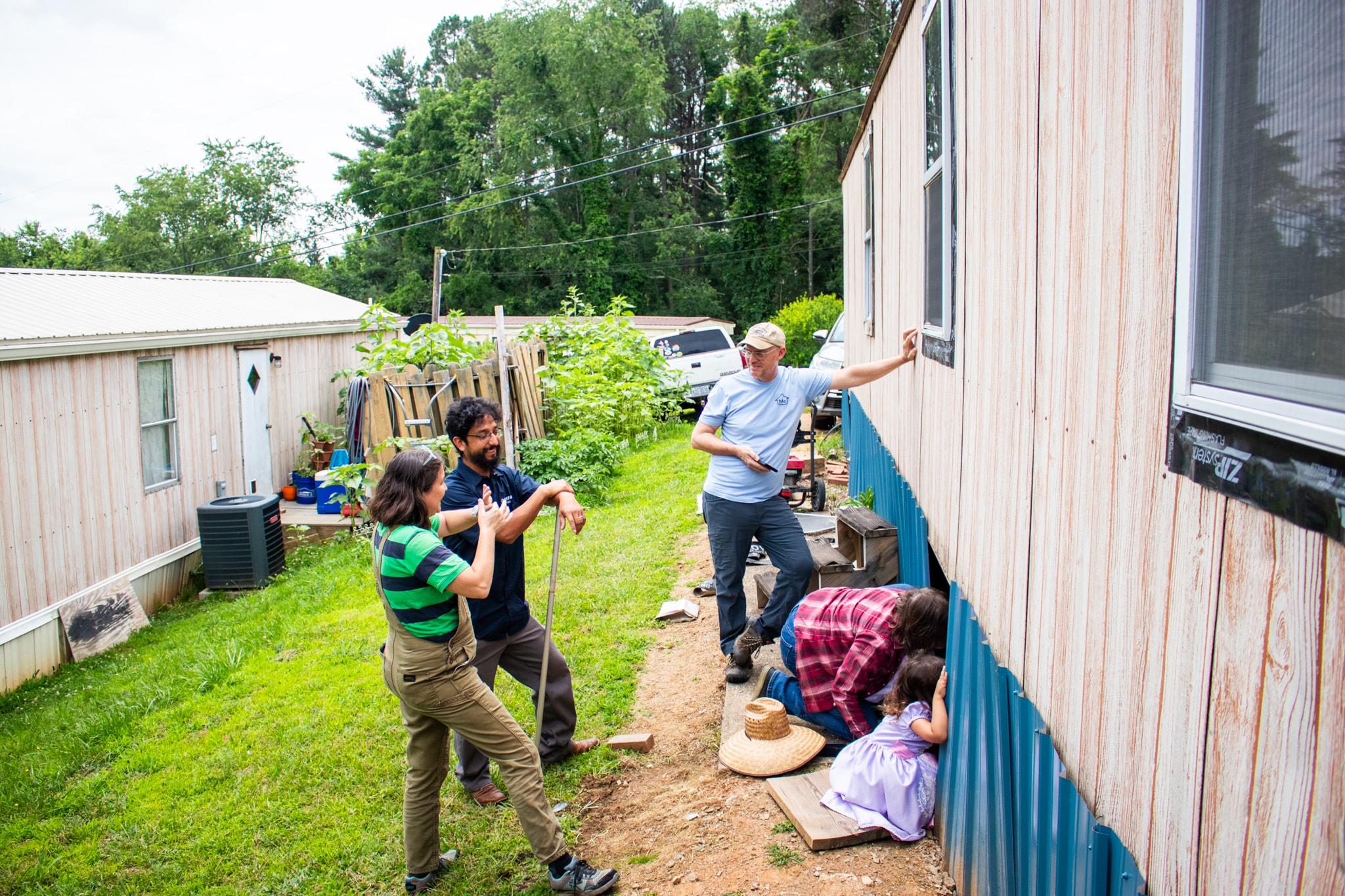
The team—and a little helper—inspect the foundation of the prototype home.
Helene made the case for a more resilient energy system in Asheville painfully clear. In the wake of the hurricane, hundreds of thousands of people across the Carolinas were left without power for weeks—much of the electrical grid had simply been washed away.
For Seed Commons member PODER Emma, the obvious thing to do was to help the low-income mobile home parks they have helped convert to cooperative ownership go solar, so that when the next disaster strikes, the lights would stay on. But there was a problem to solve: the engineer they had brought in to help was adamant that the roof of a trailer just wasn’t designed to hold up an array of solar panels.
Having energy that isn’t dependent on the grid is a lifeline in a disaster. But our irrational economic and extractive system makes resilience and sustainability a privilege, even when the long-term cost savings from renewable power would also do the most good for low-income households—the same families that are also the most vulnerable when climate disasters strike.
In the face of this extractive system, PODER Emma is building something different—an alternative grounded in mechanisms of collective survival and wellbeing. The multiple mobile home parks they’ve converted into resident-owned cooperatives are far from simply “naturally occurring low-income housing,” they are sites of community, beautiful and precious, built into the sides of the mountainous terrain around rapidly gentrifying Asheville. These cooperatives are then woven into a larger anti-displacement strategy, alongside grassroots organizing, mutual aid, inclusive industrial development, and the creation of community space.
Part of this is figuring out what the green transition could look like in their neighborhoods. What would it mean to invest in sustainability and resilience for the communities that an industry focused on the high-end of the market often overlooks or simply ignores? Once this was figured this out, could Chispas, the worker cooperative construction PODER Emma has launched and grown be trained to replicate it?
This isn’t just abstract blue sky visioning. If you want to go beyond vague ideas about how nice green infrastructure would be in theory you actually need some concrete answers, filling in the real, practical gaps in knowledge about how to affordably make low-cost mobile housing energy efficient. Thanks to a grant, PODER Emma had pulled together a team to conduct this exploratory research, with architects, engineers, designers, and building scientists together with the worker-owners of the Chispas construction cooperative and a steering committee of residents from existing mobile home cooperatives. Starting with a trailer left empty when a resident left one of the cooperatives, the team got to work figuring out how to build a green future for this kind of affordable housing.
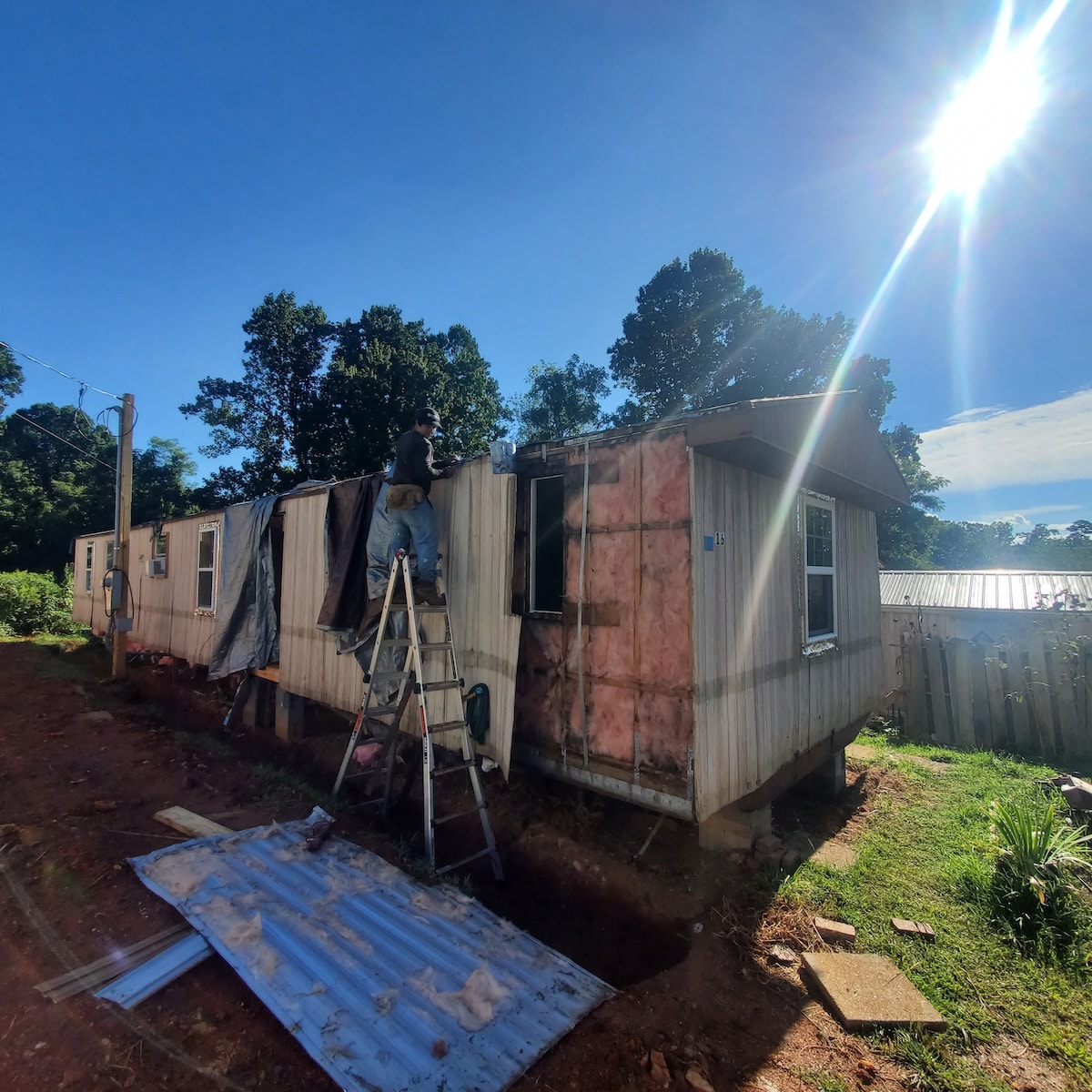
Getting started on re-insulating and re-sealing the prototype home.
Some of this is fairly straightforward. The systems in mobile homes, for instance, tend to be already electric, so there’s no need to worry about electrification, but you do need to upgrade some often pretty terrible HVAC equipment to modern heat pumps and improve the ductwork.
Some of this is a little tricky. You’ve got to figure out the best way to get the trailer envelope sealed and insulated, so that you’re not wasting energy—something especially important with surging power prices. PODER Emma’s architect helped figure out how you can add a few additional support piers to take the weight of additional insulation and sheathing.
And some of it is impossible—like using the roof of a mobile home to support solar panels. These homes are built in factories, and delivered in one piece. There’s no way the engineer working with PODER Emma would be able to certify that it could handle the load of a solar array without ripping off the roof membrane and identifying every single structural member inside. Then you’d have to repeat this for every additional different trailer you were trying to go solar with.
But where the experts came up short, the community had a solution.
Trailers are small, and having more space outdoors to hang out, say hi to neighbors, and enjoy a sunny afternoon, is a real benefit. What if you built a covered porch outside the trailer, and mounted the solar panels to that?
The engineer loved this solution, and was able to create the stamped drawings for it so that Chispas could replicate it for each new project. Because the community was empowered as a real partner in the research process, the solution that worked would come with additional benefits for residents and the community.
This project is much bigger than just this one trailer. All of this research, design, and experimentation is aimed at collecting the data necessary to figure out exactly how to go green with an existing stock of manufactured housing, a result they are going to be excited to share widely. The team is running blower tests to find leaks and measure how best to seal them up. They are tapping into the electrical system of five different trailers with circuit level monitoring, so that they can identify exactly where power is being used, and what the real impact of various interventions would be on a community member’s monthly electrical bill. With all this data in hand, they are going to be able to craft a non-extractive loan program that funds solar and efficiency upgrades out of those calculated monthly savings.
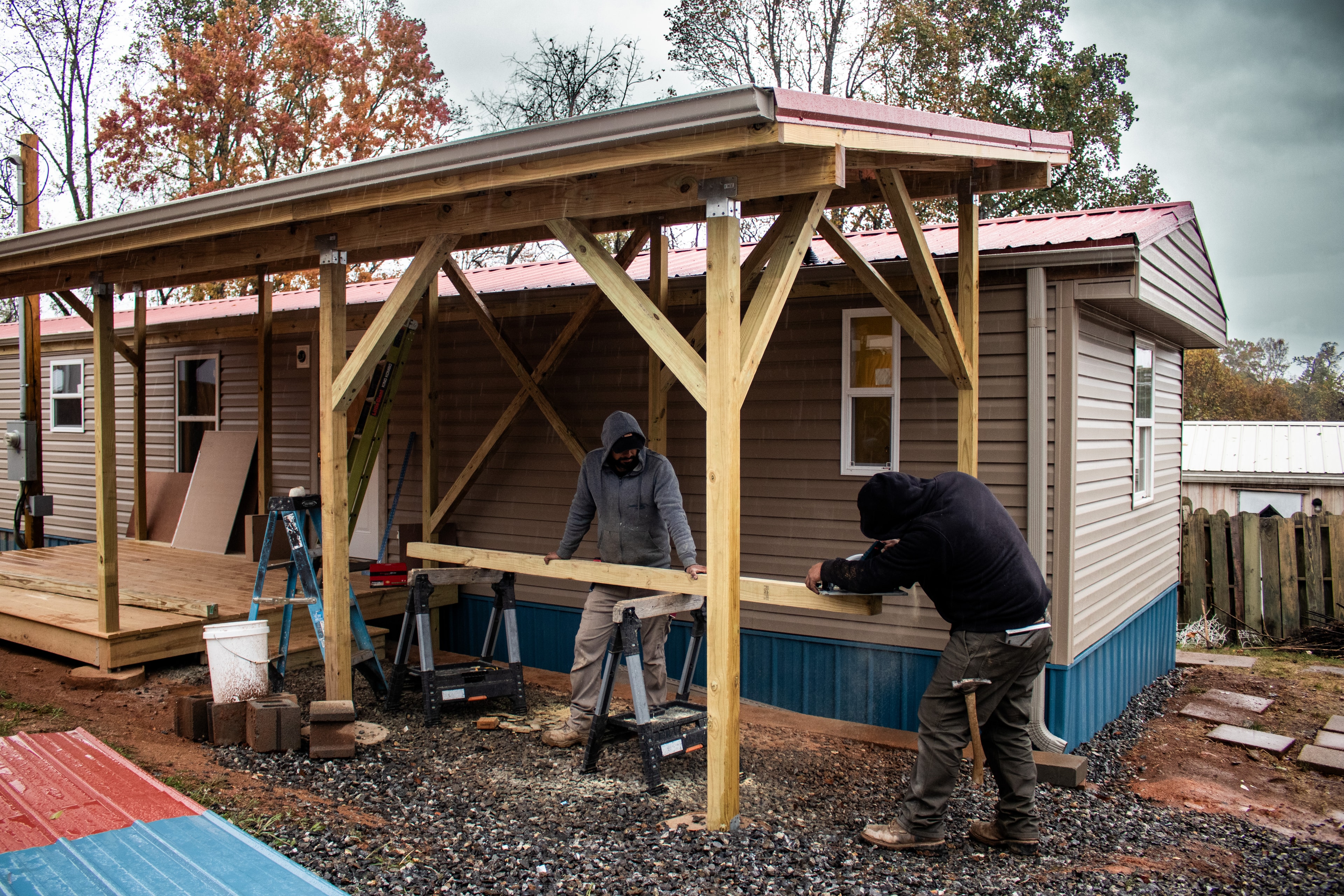
The Chispas cooperative builds the solar porch.
Getting all of this rigorous science and engineering done, coupled with the team’s architect, coDevelop architecture, and its general contractor, McBride Construction, training the Chispas cooperative to implement all the recommendations efficiently, means that PODER Emma isn’t just going to be able to make the units in their own cooperative communities more resilient, comfortable, and affordable—they are going to be developing the industrial capacity to do this across the region. Even here they are thinking bigger: one possibility is layering in an additional layer of sustainability by exploring, with their friends down the road at Morganton’s Industrial Commons, whether or not the worker-owned textile reuse capacity being built there could provide the extra insulation material needed from fabric waste streams. And because one of PODER Emma’s next projects is setting up a brand new mobile home park on a recently purchased empty plot of land, they are benchmarking their retrofit methodology against custom built modular new construction, and thinking about how they might build worker-owned industrial capacity not just in renovation, but in manufacturing.
This is a bold vision for what building a sustainable and resilient future looks like when excluded communities have a real seat at the table. It parallels similarly bold work being done elsewhere in Seed Commons, like the experiments in the green reconstruction of West Baltimore vacants being spearheaded by Waterbottle Cooperative and BRED, or the worker-owned green construction capacity taking root thanks to Co-op Cincy. The hope had been that these community and worker-driven solutions could have been funded, at scale, by some of the investments in the green transition for low income communities that had been teed up by the Biden administration and approved by Congress—but those commitments have been now largely rescinded and canceled. Thankfully, that doesn’t mean the vision needs to be shelved. As members of Seed Commons, PODER Emma and its peers are able to continue the work, drawing on a growing national pool of cooperatively governed non-extractive investment capital to move forward on the ground.